


Toxic Black Mold Spores and Mycotoxins
Like other molds, toxic black mold (or the official name: Stachybotrys chartarum) reproduces by spreading its spores. And also like other mold, the spores of toxic black mold are allergenic. Unlike most mold spores though, Stachybotrys spores are also toxic since they carry mycotoxins.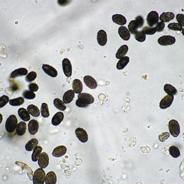
Toxic black mold spores
Toxic Black Mold Spores
In a toxic black mold colony the spores are kept within a slimy, gelatinous mass. Toxic black mold spores are a brownish color although they can't be seen with the naked eye of course.Under the microscope toxic black mold spores that are still attached to the mold colony look similar to a dandelion with clusters of spores growing at the end of a "stem" called hyphae.
How Toxic Black Mold Spores Spread
The wet coating of a toxic black mold colony usually prevents its spores from becoming airborne. If its moisture source runs out though, a toxic black mold colony can dry out and release many of its spores into the air. When toxic black mold is dry it looks gray and powdery. Other things like changes in humidity can also trigger the release of toxic black mold spores.Disturbing toxic black mold can also cause a lot of toxic spores to enter the air. This is why you should never disturb or try to remove toxic black mold if you find it in your home. Removing toxic black mold is much more dangerous than removing ordinary mold and it should only be done by a professional. There is more information about removing toxic black mold at Toxic Black Mold Removal.
Toxic black mold spores are heavy compared to other mold spores and so they do not remain in the air for very long. If toxic black spores do not land on a suitable surface to grow on then they die soon after being released. The dead spores are still just as toxic to humans though.
Toxic Black Mold Mycotoxins
It is the mycotoxins that make toxic black mold and its spores toxic to humans. These mycotoxins can be found throughout all parts of toxic black mold.Trichothecene Mycotoxins
Toxic black mold produces a group of mycotoxins called trichothecenes. Trichothecene mycotoxins are extremely toxic. The trichothecene types below are found in toxic black mold:- Cyclosporin
- Roridin E
- Satratoxin F, G and H (the most abundant type of trichothecene)
- Sporidesmin G
- Stachybotryolactone
- Trichoverrol
- Trichoverrin
- Verrucarin J
For more information about trichothecenes visit Trichothecene Mycotoxins.
For more information about mycotoxins in general visit Mycotoxins.
Toxic Black Mold Mycotoxin Production
Although toxic black mold can produce mycotoxins it doesn't do so all the time. Factors affecting whether toxic black mold produces mycotoxins include the material toxic black mold is growing on, temperature, humidity and perhaps other unknown conditions.Environmental conditions which are suitable for toxic black mold to produce mycotoxins are 55% or higher humidity along with fluctuating temperatures. Stress may also cause toxic black mold to produce mycotoxins. When it is growing on certain materials toxic black mold might not produce mycotoxins.
Toxic Black Mold Mycotoxin Exposure
A person might suffer toxic symptoms from toxic black mold mycotoxin exposure by ingestion of mycotoxin contaminated food. Toxic black mold can contaminate crops such as grains and can survive cooking. However crops are treated to remove mycotoxins after harvest.Besides through ingestion, people can also be poisoned by toxic black mold mycotoxins through inhalation. In tests on animals toxic black mold mycotoxins have been found to be 40 times more toxic when inhaled compared to when ingested.
A person might suffer toxic symptoms by breathing in airborne toxic black mold spores which contain mycotoxins or breathing in fragments of the mold which can also become airborne and also contain mycotoxins. When toxic black mold is growing inside houses the occupants are of course affected primarily through breathing in the mycotoxins.
Toxic black mold mycotoxins can also enter into a person's body through the skin.
The symptoms which exposure to toxic black mold mycotoxins can cause are at Toxic Black Mold Symptoms.
Toxic Black Mold Mycotoxins in Agriculture
Besides in buildings, toxic black mold mycotoxins have also been a problem outdoors in agriculture. In the 1930s and 40s there was an outbreak of stachybotryotoxicosis in farm animals in Eastern Europe. (Toxic Black Mold History)Since then much of the toxicity and effects of ingesting toxic black mold mycotoxins have been observed in animals. Horses in particular are affected by mycotoxins and reportedly a horse will die from ingesting as little as 1mg of trichothecene mycotoxins.
Toxic black mold mycotoxins contaminating harvests such as grains, corn, coffee and soy are also a problem for agriculture. However crops are treated after harvest to remove mycotoxins and minimize human mycotoxin exposure through ingestion.