


Mold Testing
Mold testing can tell you if you have a mold problem in your home. Mold tests can also help you find hidden mold, measure your indoor air quality and identify what species of mold is in your home.Professional Mold Testing
It's best to have mold testing performed for you by a qualified mold professional. Hiring a professional mold tester who is experienced at collecting and analyzing mold samples will always lead to the most accurate results.Mold Test Kits
You can purchase mold test kits which you can use to collect mold samples yourself. This is a less expensive option than having a mold tester test your home. The samples you collect will be sent away to a professional mold testing laboratory which will get back to you with the results.Multiple Mold Tests
A mold test gives you a snapshot of the amount of mold particles in a certain area at a certain time. But the amount of mold spores fluctuates over time and from place to place.Because of this it's a good idea to test at several different times and in different locations in your home. This way you will get a more complete and accurate picture of the mold problem in your home.
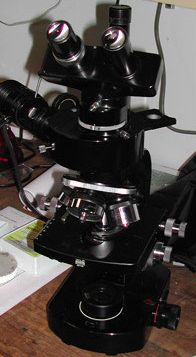
examining mold samples
Types of Mold Tests
The three main types of mold tests are:- Air testing
- Surface testing
- Bulk testing
Ideally you should use all three types of tests since each have their own strengths and weaknesses.
Air Testing for Mold
Air sampling tests the concentration of mold spores in your home's air. Samples are taken from the air and are later examined under a microscope.Air tests can tell you if you have a mold problem even if you cannot find the mold growth. However the amount of mold spores in the air can change drastically in a small amount of time, giving varying results at different times.
Surface Testing for Mold
Surface testing takes samples from household surfaces to find the amount of mold growth and spores deposited around the home. Samples are collected by swabbing, tape lifting or other methods. The sample is then examined in a laboratory.Like with air testing the results can vary because mold growth and spores aren't spread evenly across surfaces in the home and can change over time. Unlike air testing though, surface tests can't identify the exact concentration of mold spores in the air.
Bulk Testing for Mold
Bulk testing involves collecting pieces of material from the home. The material is then taken to a laboratory where mold particles on the material can then be examined under a microscope. Bulk tests can tell you if you have a mold problem and give you an idea of the concentration of mold particles in your home.Culture Tests for Mold
Culture tests are where mold particles in a sample from the home are grown into larger mold colonies in a lab. This way culture tests identify the species of molds in houses.Only mold particles that are still alive can be grown. However dead mold particles in the home still cause allergies and health problems. Other tests can detect both living and non-living mold in a home but can't always identify the species of molds.
Why You Should Test for Mold
The main reasons for having mold testing performed in your home are:- You notice signs of mold such as a mold smell or mold symptoms
- To identify the species of mold in your home
- To help you find where mold is growing
- To test indoor air quality by measuring the amount of spores in the air
- To test if mold in your home has been fully removed
Mold Signs
One sign you could have mold is a mold smell. If you notice a moldy smell in your home there's a good chance you could have mold hidden somewhere.Another sign that you could have mold is if you are suffering allergic symptoms. If there's mold hidden in your home there will be mold spores in the air. When you breathe these spores in not only will you notice a moldy smell but your body will react with allergic reactions like sneezing, a runny nose or sore eyes. For a more detailed list of symptoms mold causes go to the Mold Symptoms page.
Some more signs that you could have a mold problem and need to have mold testing are at Mold Signs.
Identifying Mold Species
Another reason for mold testing is if you want to find out what kind of species of mold is in your home. This is important for toxic molds since extra caution needs to be taken to safely remove toxic mold from the home.Two well known toxic molds are Stachybotrys (often called toxic black mold) and Aspergillus.
If you see mold which looks like a toxic species or if you are suffering toxic symptoms then you should have it tested before you try to remove it. The only way to identify the species of a mold colony for certain is to have a mold professional look at a sample of it under the microscope.
The symptoms caused by Stachybotrys are at Toxic Black Mold Symptoms.
Mold Testing to Find Mold
Not only can mold testing tell you if you have a mold problem somewhere in your home, but it can also help you to find it.Mold often grows hidden away behind walls and other places. Mold tests can help you narrow down the location of hidden mold by telling you the places in your home with the highest amount of mold spores.
You can find out places mold commonly grows in the home at Where Mold Grows.
Mold Testing for Indoor Air Quality
You can have mold testing done to tell you the amount of mold spores in the air.Sometimes you can be suffering the symptoms of mold allergies even if there is no mold growing in your home. This can be because of mold spores blowing into the home from outdoor mold or because there used to be mold growing in your home which left behind a build up of spores.
By testing for mold you can tell if there is an unhealthy level of spores in your house and find out if any allergies you might have are from mold or something else.
Mold Testing after Removing Mold
Mold testing can be useful after you've had mold removed from your home. Through testing you can make sure that the mold removal was a success.Surface sampling can show whether an area has been properly cleaned of mold. Having air testing some time after the mold removal can also confirm that mold spores in your home's air have been reduced to a safe level.
There's a guide to removing mold from your home at Mold Removal.
Mold Inspection before Testing
Before you turn to mold testing you should have a thorough mold inspection of your home done. If the inspection turns up mold then usually you don't need to do any mold testing. Instead you can move onto the mold removal stage.But if you couldn't find any mold but still think you have a mold problem, or if you found some mold but think there is more hidden or that it could be toxic, then it's time to turn to mold testing.